

Inordinate Delay: Causes and Solutions

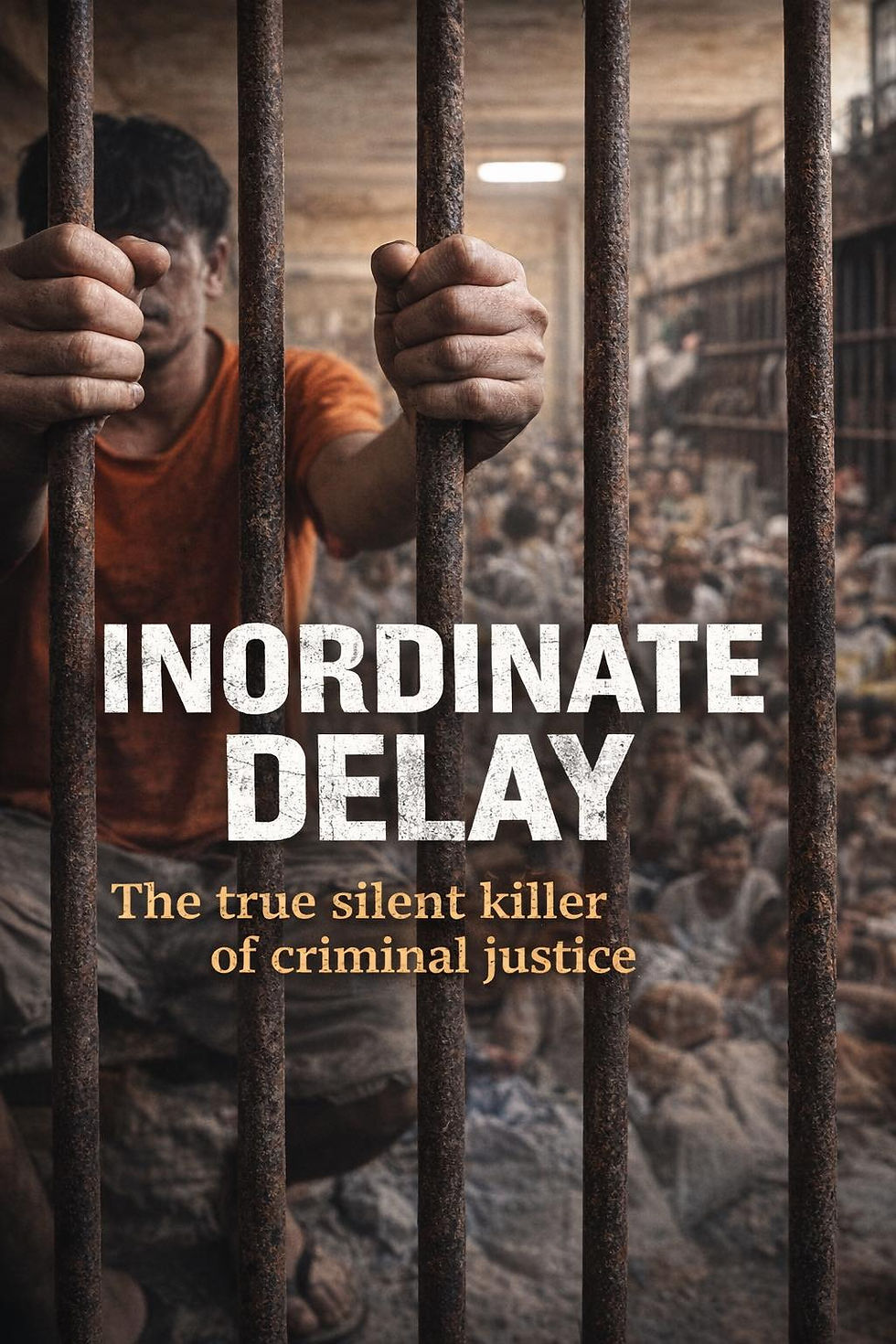
Inordinate delay in case disposition is the silent killer of the justice system. It does not create the spectacle of police shootings. It does not produce the drama of high-profile corruption cases. Yet it quietly destroys lives, erodes trust, and undermines the legitimacy of institutions. It is the slow violence of the criminal justice system.
In my previous works on prolonged trial detention and jail congestion, I have repeatedly emphasized that delay is not a mere administrative inconvenience. It is a form of punishment in itself. Thousands of Persons Deprived of Liberty (PDLs) in the Philippines languish in jail for five, ten, or even fifteen years without conviction. Metro Manila detention data often show average pretrial detention exceeding 500 days, with many far beyond this figure. Facilities designed for a few hundred now house thousands, resulting in congestion rates exceeding 286 percent, and in some jails reaching more than 1,000 percent. These are not statistics. These are lives placed on hold.
The problem of inordinate delay can be understood through three interrelated dimensions: structural, organizational, and cultural causes. These dimensions are not isolated; they reinforce each other, creating a self-sustaining system of delay.
Structural causes refer to the material and institutional constraints of the justice system. There is a shortage of prosecutors, public defenders, and judges. Courts lack staff, office space, equipment, and technological support. In many areas, a single prosecutor handles hundreds of cases simultaneously. Public defenders carry overwhelming caseloads, limiting their capacity to prepare adequately. Judges preside over overcrowded dockets, often hearing dozens of cases in a single day.
Added to these constraints are environmental factors such as traffic congestion, flooding, and transportation barriers. Hearings are postponed because lawyers cannot arrive on time, witnesses fail to appear, or court staff are unable to process documents. These are inadvertent delays, but their cumulative effect is enormous. Structural limitations create a justice system that moves slowly by design.
Research in court administration confirms that heavy caseloads and insufficient resources significantly increase disposition time (Church et al., 1978; Ostrom & Hanson, 2010). Studies in developing justice systems likewise show that under-resourced courts produce systemic delay and case backlog (Dakolias, 1999). The Philippine experience reflects these findings.
Organizational causes relate to inefficiencies in coordination and management. Hearings are scheduled without regard to the availability of prosecutors, defense lawyers, or witnesses. Notices are served late or not at all. Courts over
calendar cases, assuming that most hearings will be postponed. This creates a vicious cycle: because postponements are expected, more cases are scheduled than can realistically be heard, resulting in further postponements.
Data exist, but they are not utilized. Judges conduct quarterly jail visits as required by the Supreme Court. Jail authorities maintain alpha lists showing the length of detention and credit accrual under the Good Conduct Time Allowance (GCTA) law. Court data management systems identify overstaying detainees. Yet these data remain compliance documents rather than decision tools. They are submitted, archived, and forgotten.
In governance literature, this phenomenon is described as “symbolic compliance” (Meyer & Rowan, 1977), where institutions perform formal requirements without substantive follow-through. The result is predictable: information that could prevent injustice is not used to prevent injustice.
Cultural causes are perhaps the most difficult to confront. These involve norms, incentives, and professional practices that tolerate or even encourage delay. Lawyers request postponements due to conflicting schedules, lack of preparation, or strategic advantage. Professional courtesy discourages judges from denying postponement requests. Some lawyers are compensated on a per-appearance basis, creating financial incentives to prolong cases.
Criminological theories help explain these behaviors. Organizational deviance theory (Vaughan, 1999) suggests that deviant practices become normalized when they are routinized and embedded in institutional culture. What begins as occasional delay becomes standard practice. Sutherland’s differential association theory (1947) reminds us that professionals learn norms from their peers. When delay becomes acceptable behavior, it becomes transmitted across generations of legal practitioners.
The consequences are profound. Delay benefits those who can afford bail. Accused individuals who are financially capable can prolong proceedings, hoping that witnesses become unavailable, evidence weakens, or public interest fades. Over time, they may argue that their right to speedy trial has been violated, seeking dismissal of the case.
Conversely, delay punishes the poor who cannot afford bail. Prolonged detention becomes a form of informal punishment even before guilt is established. Prosecutors may feel less urgency, knowing that the accused is already deprived of liberty. Even acquittal cannot restore the years lost.
This dynamic reflects what Feeley (1979) described as the process becoming the punishment. In the Philippine context, the process is often more punitive than the penalty itself.
Delay also contributes significantly to jail congestion. When cases remain unresolved, detainees accumulate. Congestion leads to deteriorating living conditions, increased violence, spread of disease, and reduced access to rehabilitation programs. The justice system thus produces secondary harms that extend beyond the courtroom.
The solution is not merely to reduce delay but to transform the incentives that produce it. Cases must be prepared thoroughly before filing, consistent with Department of Justice policies requiring prosecutors to ensure prima facie evidence before initiating prosecution. Continuous trial systems should be strengthened to minimize postponements. Courts must strictly regulate motions for postponement and require clear justification.
Technology must be used effectively. Case management systems should flag prolonged detention cases automatically. Judicial performance metrics should include disposition speed, balanced with fairness considerations. Coordination between prosecutors, defense lawyers, and courts must be institutionalized through structured scheduling practices.
Equally important is cultural reform. Legal actors must recognize that delay is not a neutral procedural matter but a justice issue. Professional responsibility requires timely resolution of cases. The ethical obligation of lawyers is not merely to advocate but to ensure that justice is administered efficiently and fairly.
Justice delayed is justice denied, but in the Philippine setting, justice delayed is justice distorted. It punishes the innocent, rewards the guilty, congests the jails, and erodes public trust.
The objective is simple: try and convict the guilty as expeditiously and meritoriously as possible, while ensuring the protection of due process rights. The innocent must be released promptly. The guilty must be held accountable swiftly. The credibility of the justice system depends not only on correctness of decisions but on timeliness of decisions.
Delay is not merely inefficiency. It is injustice in slow motion.
Selected references:
Feeley, Malcolm M. (1979). The Process is the Punishment: Handling Cases in a Lower Criminal Court. New York: Russell Sage Foundation.
Meyer, John W., & Rowan, Brian (1977). Institutionalized organizations: Formal structure as myth and ceremony. American Journal of Sociology, 83(2), 340–363.
Sutherland, Edwin H. (1947). Principles of Criminology (4th ed.). Philadelphia: Lippincott.
Vaughan, Diane (1999). The dark side of organizations: Mistake, misconduct, and disaster. Annual Review of Sociology, 25, 271–305.
Church, Thomas W., Carlson, Alan A., Lee, Jo-Lynne, & Tan, Teresa (1978). Justice Delayed: The Pace of Litigation in Urban Trial Courts. Williamsburg, VA: National Center for State Courts.
Ostrom, Brian J., & Hanson, Roger A. (2010). Achieving High Performance: A Framework for Courts. Williamsburg, VA: National Center for State Courts.
Dakolias, Maria (1999). Court performance around the world: A comparative perspective. World Bank Technical Paper No. 430.


Comments